It seems I was a little premature in my last blog: “calm after the storm” was a bit of a misnomer, it should have been “calm between the storms” as we came in for another battering on Sunday night and awoke to torrential rain hammering on our roof and gale force winds roaring through the Beech trees that tower above our cottage. The breakfast news reporter announced gleefully that Devon and Cornwall were now cut off from the rest of the country as rail links had been severed by flood water for the third time in as many years (video footage of railway tracks suspended in mid air). Cut off?? Really? Has the M5 ceased to exist? How would the replacement bus service connect us with the mainland?
It is a well known fact that here in the UK we are obsessed with the weather. We cannot pass time of day without mentioning it, it is our default topic for filling those awkward silences “lovely weather for the time of year?” “Miserable isn’t it?” The more optimistic of us may add: “though they say it’ll brighten up later”. I sometimes wonder what people in countries whose weather is more reliable than ours talk about? Presumably you would be considered a little strange extolling the virtues of a beautiful day after unbroken weeks of glorious weather. With immaculate timing and as if to prove my point perfectly, Malcolm has just returned from the pub in the village and announced that it’s “freezing cold” outside, “there’ll be a frost tonight!”
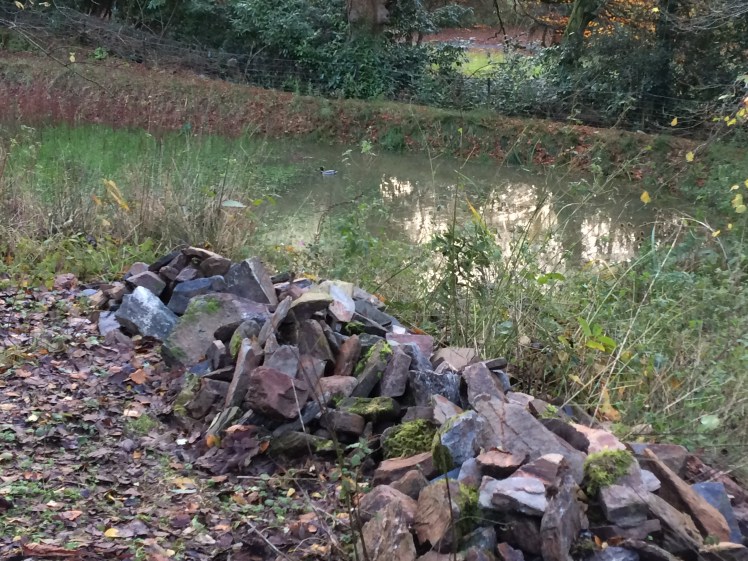
I squelched my way across the field on my way to feed the sheep. As I passed the pond I was pleased to see that the level had risen further, enough for our pair of wild mallard ducks to take up residence again. I managed to take a quick photo before they spotted me and took off, in alarm, quacking noisily. Our paths and tracks were raging torrents – the run off from our neighbour’s field. There was a stream running through Malcolm’s Dad’s greenhouse and it was already under 30cm of water. Seeing this I was a little apprehensive about my journey to work.
My fears proved not to be unfounded. The lane that leads to my workplace down in the valley is narrow and winding with the high hedge banks so typical of Devon lanes. It was hard to discern in places whether it was indeed a road or a river. About two thirds of the way down there is a dip that can fill with water, predictably it had this morning and I now had to decide whether to attempt to drive through it or to turn back and go a different, much longer way. I had before now been accused of being a “woose” by work mates for not driving through the flood water here, even Pete in his MG sporty “hairdresser’s car” has been known to drive through it, and I have a 4 x 4. All the same, cars have come to grief and been written off, so not to drive through can be a sensible decision and is not necessarily wimping out. On this occasion I was feeling a little more daring and decided to go for it. I put my foot down and set off. All was going well until about halfway across when I felt the car slow down and begin to float. With panic rising I gritted my teeth, put my foot down even harder and willed the car forward. After initial resistance, to my immense relief we made it to the other side without stalling and no warning lights flashing! (If Malcolm is reading this, I won’t do it again, promise!) When I pulled into the car park, feeling a little foolish, but also secretly proud of my achievement, the wind was soon taken out of my sails for there, parked in the corner, was Pete’s car!
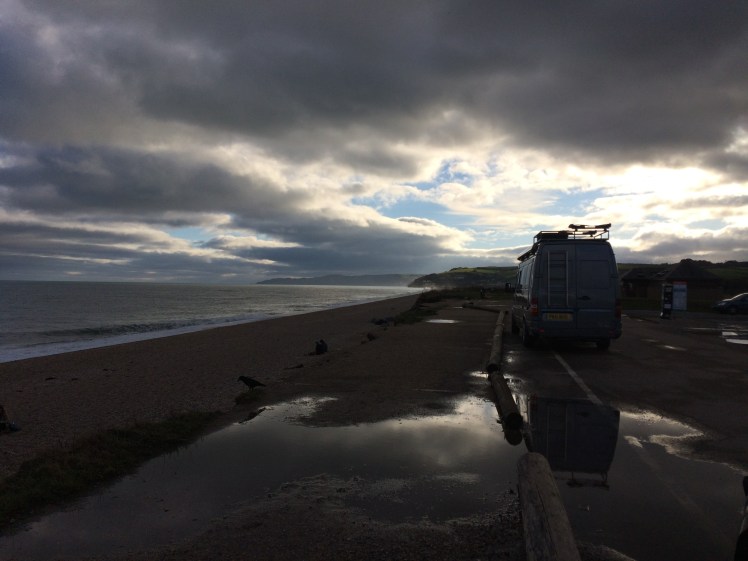
On a more serious note: our weather has become more extreme in recent years we are constantly breaking records for being the hottest, wettest, driest, having the strongest winds etc., etc. All strong evidence for climate change and global warming. Our coastline has taken a terrible battering. You may have seen news reports back in January 2014 showing the railway lines at Dawlish hanging dramatically in mid air, with waves crashing over them in mountainous seas. These same seas ravaged our coastline and changed it forever with cliffs collapsing into the sea in places. Half the car park at Slapton Sands has disappeared and the part of the “line” (a stretch of the A379 between Kingsbridge and Dartmouth, which traverses a narrow strip of land between the freshwater lagoon and nature reserve “Slapton Ley” and the sea) was washed away. South Milton Sands was also unrecognisable with the road and part of its car park swept away. Most weeks I take my elderly parents to see the sea at Slapton Sands, one of the pictures below was taken on one such visit. For many years I wondered why it was called “sands” when it was most definitely all shingle. Apparently, historically, it was a sandy beach but dredging for Devonport dockyard had a catastrophic on all the beaches on that stretch of coast and the sand disappeared and was replaced by stones. Interestingly, the storms of recent years have reversed this a little and the beach at Slapton is starting to look more sandy.
 Never Mind the Bullocks